When we look back on immigration enforcement in the early twenty-first century, the impact of US migration enforcement policies will be measured in totals. How many experienced the brutality of an ICE arrest? How many people were detained? How many people were forcibly separated from their families and communities and removed from the United States?
I’ve spent a lot of time over the last couple years focused on ICE detention, so that’s what this post will focus on.1 Here’s the takeaway statistic:
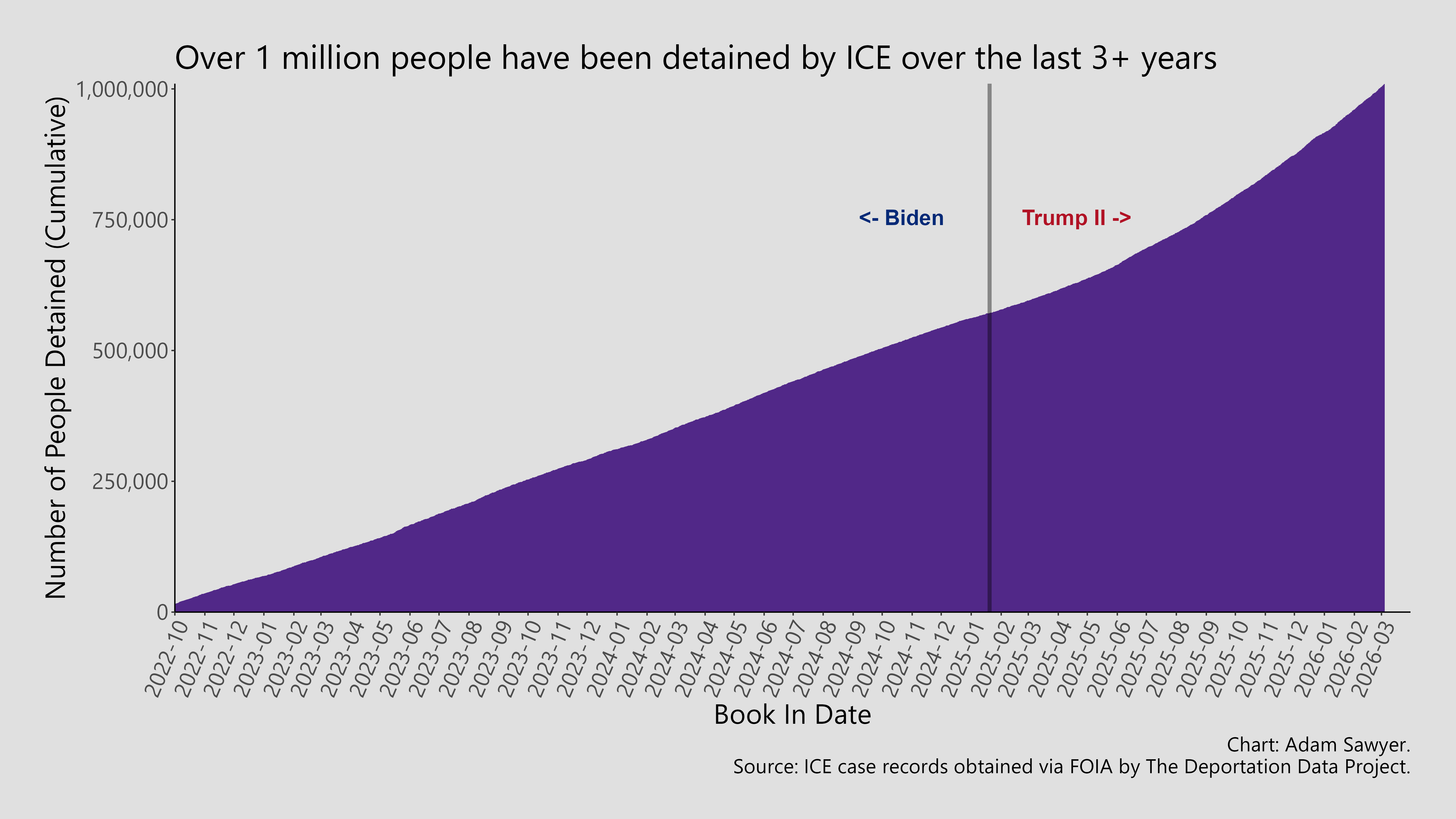
Over one million people have experienced ICE detention over the last three-and-a-half years.
We can further break this down by administration.
In the final 28 months of the Biden administration, more than 607,000 people were booked into an ICE facility.
In the first 14 months of the second Trump administration, more than 450,000 people were booked into an ICE facility.
I posted all of this on Bluesky earlier this week. The calculation itself is fairly straightforward. You can inspect my code here.
Altogether, there are 2.6 million records in the detention book ins files. This does not mean 2.6 million people were booked into ICE detention over the time span of Oct. 2022 to March 2026. We know both from reporting and from the data itself that a person can have book ins to multiple detention centers over the entirety of one’s stay in ICE custody. These are detention book ins data so one record does NOT equal one person. Each entry marks another moment when ICE booked someone into a detention facility.
The “Anonymized ID” column in the ICE case records is what allows us to get a count.2 Each person detained by ICE has been assigned a randomly generated series of characters that no one else has. Using this, we can identify when a person was first booked into ICE detention and then drop subsequent transfers.
I counted the number of unique IDs that have at least one book in date. It amounted to 1,022,195 unique people booked into ICE detention since October 2022.
Here is that statistic as a chart, cumulative across both administrations.
I wanted to compare book ins across the most recent two administrations, so I converted the start of the book ins data, October 1, 2022, to the starting point for ICE detention trends under the Biden admin. 842 days elapsed before the start of the second Trump administration, on January 20, 2025. Another 415 days passed before the end of the available records, on March 10, 2026.3 That’s this chart.
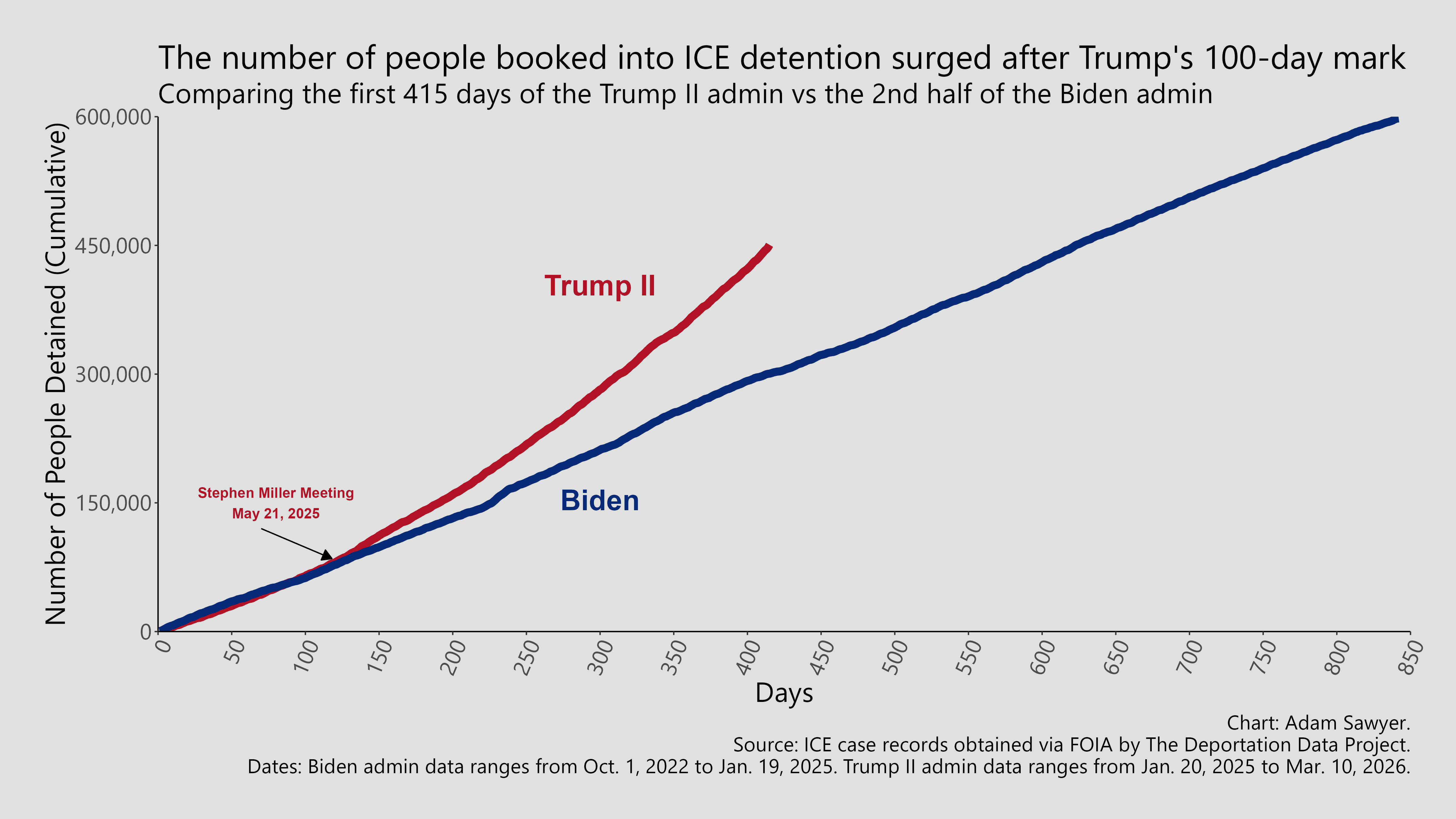
Book ins surged when Stephen Miller set the arrest quota in May 2025, around Trump’s 120th day back in office.
Some final notes.
I have carefully used terms like at least and over and more than throughout this document. There are four ways that I consider it likely that more than 1,022,195 people have been detained by ICE over the last three-and-a-half years.
Time. Based on when this data was extracted, certain individuals were already detained on October 1, 2022 and never had occasion to get entered into this particular file, perhaps because ICE released or removed them.
Type of facility exclusions. ICE seems to have excluded book ins to hospitals and youth shelters in the most recent data production.
The murkiness of detention custody under federalism. Sometimes, agencies at the federal, state, or local level have custody of a person for other charges, but the purpose of their continued detention is de facto for immigration purposes.4
Extrajurisdictional detention. Book ins at detention camps in other sovereign countries are not logged in this ICE data production even though the transfer and custody of these individuals to overseas gulags are paid for by the US taxpaying public. Most of these individuals were likely counted when first booked into stateside facilities, but a transfer to say, CECOT in El Salvador, would count as a removal and not as a book in, even if the individual immediately enters detention upon arrival in the destination country.
Thousands of people are going to show up today, April 25, 2026, to protest the proliferation of migration detention in the United States. Understanding the scope of the atrocity that is migration detention means we have to recognize both where we are now and how we got here.
Footnotes
This is based on my analysis of ICE detention book ins case records that The Deportation Data Project obtained following a FOIA lawsuit.↩︎
A total of 7,341 book in logs, or about 0.3% of the 2.6 million records, don’t have a unique ID. Dr. Graeme Blair at The Deportation Data Project has a clever way to address these without tossing them out. As long as a record doesn’t duplicate other records in the database, assign the row number as that record’s ID along with a “no ID” prefix.↩︎
ICE extracted the case records files from its dashboard at some point on March 11, 2026, meaning that there are some book ins logged to that date. However, since it does not amount to a full day, I typically exclude March 11 records from most analyses.↩︎
For a good discussion of this, read “Hiding in Plain Sight” by Jacob Kang-Brown at the Prison Policy Initiative.↩︎